
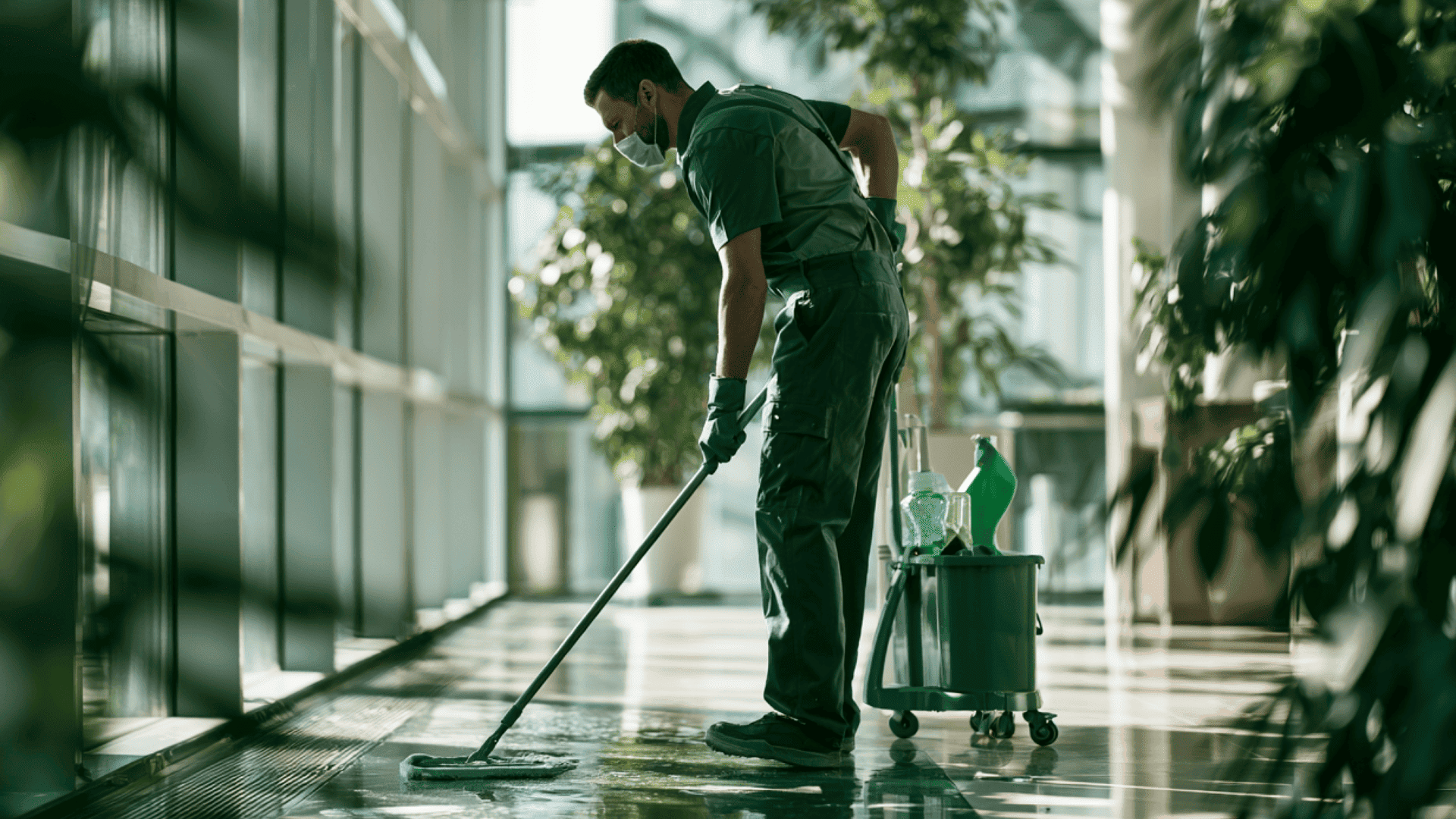
Office cleaning covers the routine work that keeps a workplace sanitary, safe, and presentable: trash removal, vacuuming, dusting, disinfecting high-touch surfaces, restroom sanitation, and floor care. Most offices need this daily or several times a week, with deeper tasks like carpet extraction and floor stripping scheduled monthly or quarterly. The right frequency, scope, and staffing model depend on your foot traffic, industry, and whether your facility handles sensitive government or corporate work.
This guide is for facility managers, office administrators, and business owners who are setting up office cleaning for the first time or reevaluating a current provider. We’ll cover exactly what a standard service includes, how often each area should be cleaned, what drives cost, and how to weigh in-house staff against outsourced crews and day porter programs.
You’ll also find data on why cleaning quality is a measurable business issue, not just an aesthetic one, along with a straight comparison of the main ways businesses staff this function today.
What Is Office Cleaning, Exactly?
Office cleaning is the routine maintenance of a workspace’s interior surfaces, floors, and shared areas to keep it sanitary and professional. It sits inside the broader janitorial and commercial cleaning industry, distinguished mainly by the setting and the frequency of service.
Office Cleaning vs. Janitorial Services vs. Commercial Cleaning
These three terms get used interchangeably, but they describe slightly different things. The table below breaks down how each is typically defined in the industry.
| Term | What It Means | Typical Frequency |
|---|---|---|
| Office Cleaning | Routine cleaning of desks, floors, kitchens, and restrooms in a professional office environment. | Daily to 3x per week |
| Janitorial Services | An umbrella term for ongoing facility upkeep, including office cleaning plus trash handling, restocking supplies, and light maintenance. | Daily or nightly, contract-based |
| Commercial Cleaning | A broader category covering any non-residential cleaning: offices, retail, warehouses, medical facilities, and government buildings, often including specialized or one-time deep-clean projects. | Varies by project scope |
In practice, most offices need a combination of all three: a janitorial contract that covers daily office cleaning, plus periodic commercial-grade deep cleaning for carpets, floors, and high-touch areas.

What’s Included in a Standard Office Cleaning Service?
A standard office cleaning service covers the tasks that need attention every day or every few days to keep a workspace usable and hygienic. Scope varies by contract, but most services include the following.
• Emptying trash and recycling, and replacing liners
• Vacuuming carpets and mopping hard-surface floors
• Dusting desks, ledges, and other surfaces
• Disinfecting high-touch points: door handles, light switches, shared phones, and keyboards
• Cleaning and restocking restrooms
• Wiping down kitchen or breakroom counters, tables, and appliance exteriors
• Spot-cleaning interior glass and glass partitions
Routine Cleaning vs. Deep Cleaning
Routine cleaning handles what’s visible day to day. Deep cleaning targets what builds up underneath it: carpet fibers, grout lines, vents, and upholstery that routine service can’t fully reach. Most facilities schedule a deep clean quarterly or semi-annually on top of daily service. We cover exactly what’s involved and how to time it in our guide to what’s included in a deep office cleaning.
Why Office Cleaning Quality Affects Your Bottom Line
Cleaning quality is measurable in dollars, not just appearance. Poor workplace hygiene contributes directly to absenteeism, lost productivity, and even compliance exposure.
• Worker illness and injury cost U.S. employers an estimated $225.8 billion annually in lost productivity, according to the CDC Foundation.
• A typical office desk carries roughly 400 times more bacteria than a toilet seat, and 92% of office phones test positive for contamination, per research cited by WebMD.
• The U.S. Environmental Protection Agency links poor indoor air quality in office buildings to headaches, fatigue, and reduced concentration among occupants.
• Federal OSHA sanitation standard 1910.141 requires employers to keep workplaces clean “to the extent that the nature of the work allows,” with waste removed often enough to avoid a health hazard.
None of this means every office needs a hospital-grade protocol. It does mean cleaning frequency and quality belong on the same list as HR policy and facility safety, not an afterthought delegated to whoever’s cheapest.

In-House Staff, an Outsourced Crew, or a Day Porter — What’s the Difference?
Businesses generally staff office cleaning one of three ways: hiring cleaning staff directly, contracting an outsourced janitorial crew for after-hours service, or adding a day porter for daytime coverage. Each has real trade-offs.
| Model | Cost Predictability | Coverage | Management Burden | Best Fit |
|---|---|---|---|---|
| In-house staff | Low — payroll, benefits, and turnover add hidden cost | Whatever hours you schedule | High — you manage hiring, training, supplies | Very large single-site campuses with dedicated facility teams |
| Outsourced nightly crew | High — fixed contract pricing | After-hours, typically nightly | Low — vendor manages staffing and QA | Most standard offices and corporate buildings |
| Day porter | High — scheduled hourly or contract rate | Business hours, on-site | Low — vendor-managed, on-demand for spills or high-traffic events | Lobbies, government buildings, and high-visibility or high-traffic facilities |
Many mid-size and large facilities blend two models: an outsourced nightly crew for routine cleaning, plus a day porter for daytime touch-ups, restocking, and visible responsiveness. This combination shows up often in government and corporate real estate portfolios where appearance and uptime both matter.
What Is a Day Porter, and Do You Need One?
A day porter is an on-site cleaning professional who works during business hours, handling spills, restocking restrooms, monitoring lobbies, and responding to issues in real time rather than overnight. Facilities with heavy foot traffic, public-facing lobbies, or strict appearance standards — like government buildings, medical offices, and REIT-managed properties — typically benefit most from adding one.
How Often Should an Office Be Cleaned?
Cleaning frequency should match how heavily a space is used, not a fixed calendar default. Here’s a general baseline most commercial facilities follow.
• Daily: restrooms, kitchens/breakrooms, entryways, trash removal, high-touch surface disinfecting
• 2–3 times per week: vacuuming carpeted work areas, dusting, glass spot-cleaning
• Monthly: baseboard and detail dusting, interior window cleaning
• Quarterly or semi-annually: carpet extraction, hard floor stripping and refinishing, upholstery cleaning
Facilities with 24/7 operations, medical components, or public visitor traffic often need daily service across every category above, sometimes with multiple passes per day.
What Drives the Cost of Professional Office Cleaning?
Office cleaning pricing is typically built around square footage, but several other factors move the number up or down.
• Frequency: nightly service costs more per visit than three-times-weekly service, but less on an annual basis than reactive, unscheduled cleaning
• Service tier: basic trash-and-vacuum service costs less than a full janitorial contract with restroom sanitation and floor care included
• Security requirements: facilities requiring cleared, background-checked staff — common in government and defense-adjacent buildings — carry a premium over standard commercial contracts
• Green cleaning certification: GS-42 or similar certified programs may cost more than conventional cleaning but reduce chemical exposure and support sustainability reporting goals
• Regional labor costs: pricing in dense metro markets typically runs higher than in surrounding suburban or rural areas
Because these variables shift so much by facility, a walkthrough and custom quote is far more reliable than a flat per-square-foot rule of thumb.

Choosing an Office Cleaning Provider: What to Look For
The right provider fits your facility’s risk profile, not just your budget. At minimum, evaluate these criteria before signing a contract.
• Proven experience in your specific facility type — government, corporate, medical, or industrial
• Documented quality assurance process, not just a verbal promise of “spot checks”
• Insurance, bonding, and — where relevant — cleared or background-checked staff
• Green cleaning certification if sustainability reporting matters to your organization
• Clear emergency response procedures for spills, weather events, or after-hours issues
We built a more detailed walkthrough of this decision in how to choose a professional office cleaning company, including questions to ask during a vendor walkthrough.
Green & Sustainable Office Cleaning
Green office cleaning uses certified low-toxicity products and practices designed to protect indoor air quality and reduce environmental impact. The most recognized standard is Green Seal’s GS-42 certification, which sets requirements for cleaning products, equipment, and staff training.
Organizations pursuing LEED certification, ESG reporting, or simply a healthier indoor environment for staff increasingly specify green cleaning in their janitorial contracts. Our commercial green cleaning services guide breaks down what GS-42 certification actually requires and how it differs from a provider that just markets itself as “eco-friendly.”
Government & Corporate Office Cleaning: Special Considerations
Government facilities and corporate headquarters carry cleaning requirements that go beyond a standard office contract. Security clearance for cleaning staff, after-hours access protocols, and strict quality documentation are often non-negotiable rather than nice-to-haves.
Facilities managing sensitive data or restricted areas typically require providers with a dedicated Facility Security Officer, cleared personnel, and a documented chain of accountability for who accessed which space and when. This is a materially different bar than a standard commercial office contract, and it’s worth confirming a provider actually meets it before signing.
Evaluating cleaning options for a government, corporate, or REIT-managed facility in the mid-Atlantic? Talk to our team about a walkthrough and custom quote.
Frequently Asked Questions
How often should an office be professionally cleaned?
Most offices need daily attention to restrooms, kitchens, and high-touch surfaces, with carpet vacuuming and dusting 2–3 times per week. Deep cleaning tasks like carpet extraction and floor refinishing typically happen quarterly or semi-annually, depending on foot traffic.
What’s the difference between office cleaning and deep cleaning?
Office cleaning covers routine, visible upkeep like trash removal and surface wiping. Deep cleaning addresses what builds up over time underneath that surface layer, including carpet fibers, grout, vents, and upholstery, and is scheduled less frequently as a separate service.
What is a day porter and do I need one?
A day porter is an on-site cleaning professional working business hours to handle spills, restock supplies, and maintain lobbies and high-traffic areas in real time. Facilities with heavy public traffic or strict appearance standards benefit most from one, on top of standard nightly service.
How much does office cleaning cost?
Cost depends on square footage, cleaning frequency, service tier, and any security or certification requirements. Because these variables differ so much by facility, a walkthrough and custom quote gives a far more accurate number than a generic estimate.
Is green office cleaning worth the extra cost?
For organizations tracking ESG goals, pursuing LEED certification, or prioritizing indoor air quality, GS-42 certified green cleaning is generally worth the premium. It reduces chemical exposure for staff and supports sustainability reporting requirements that conventional cleaning contracts can’t document.