
A day porter is a commercial cleaning professional who works on-site during business hours, keeping restrooms, lobbies, breakrooms, and high-touch surfaces clean, stocked, and safe while people are using the building. Unlike an after-hours janitor, a day porter is visible, on call, and often the first person tenants turn to when something needs attention.
This guide is for facility managers, property managers at REITs and multi-tenant buildings, and government facility administrators who want to understand the role before adding it to their cleaning program.
We’ll define what a day porter is, compare the role with five similar building jobs, and break down a day porter’s responsibilities, skills, required training, tools, and how to measure performance.
What Is a Day Porter?
A day porter is a member of a commercial cleaning team assigned to maintain a building while it’s occupied, usually on a weekday shift between 7 a.m. and 6 p.m. In building services, “porter” is the traditional title for staff who care for common areas rather than individual offices.
The role is defined by three things:
• Timing: the work happens during business hours, not after the building empties
• Scope: shared, high-traffic spaces like restrooms, lobbies, elevators, breakrooms, and entrances
• Responsiveness: a set route plus on-demand requests from tenants, employees, and property managers
Federal labor data doesn’t track day porters as a separate occupation. The closest category, janitors and building cleaners, covers about 2.4 million jobs, with a median pay of $17.71 per hour in May 2025 and about 321,800 openings each year, according to the Bureau of Labor Statistics.
Day Porter vs. Janitor, Custodian, and Other Building Roles
A day porter overlaps with several building roles but replaces none of them. The difference comes down to when each role works, what it’s responsible for, and who it serves.
| Role | When They Work | Main Focus | Typical Tasks |
|---|---|---|---|
| Day porter | Occupied business hours | Keeping shared spaces clean, stocked, and safe in real time | Restroom checks, restocking, spill response, high-touch disinfecting, tenant requests |
| Night janitor | After hours | Fully resetting the building for the next day | Vacuuming, trash removal, restroom sanitation, hard floor care |
| Custodian | Day or night, often in-house | Broad care of an institution, such as a school or hospital | Cleaning plus minor repairs, locking up, grounds work |
| Building engineer | Business hours plus on-call | Mechanical and building systems | HVAC, plumbing, electrical, and life-safety equipment |
| Concierge or front desk | Business hours | Visitor and tenant service | Check-in, deliveries, directions, access requests |
| Restroom attendant | Event or peak hours | One restroom or set of restrooms | Continuous wiping, restocking, and monitoring in a single location |
The BLS notes that custodians typically work in institutions such as schools and hospitals, while janitors and cleaners cover a broader range of buildings. In commercial offices, REITs, and government buildings, the day porter is the role that bridges cleaning and tenant service during the workday.
Day Porter Job Description: Core Responsibilities
A day porter’s responsibilities fall into five categories: hygiene, safety, supplies, tenant service, and reporting. Most of the job is preventive, catching problems before an occupant notices them.
• Hygiene upkeep: restroom checks, disinfecting door handles, elevator buttons, and push plates, wiping breakroom counters and coffee stations, emptying overflowing trash and recycling
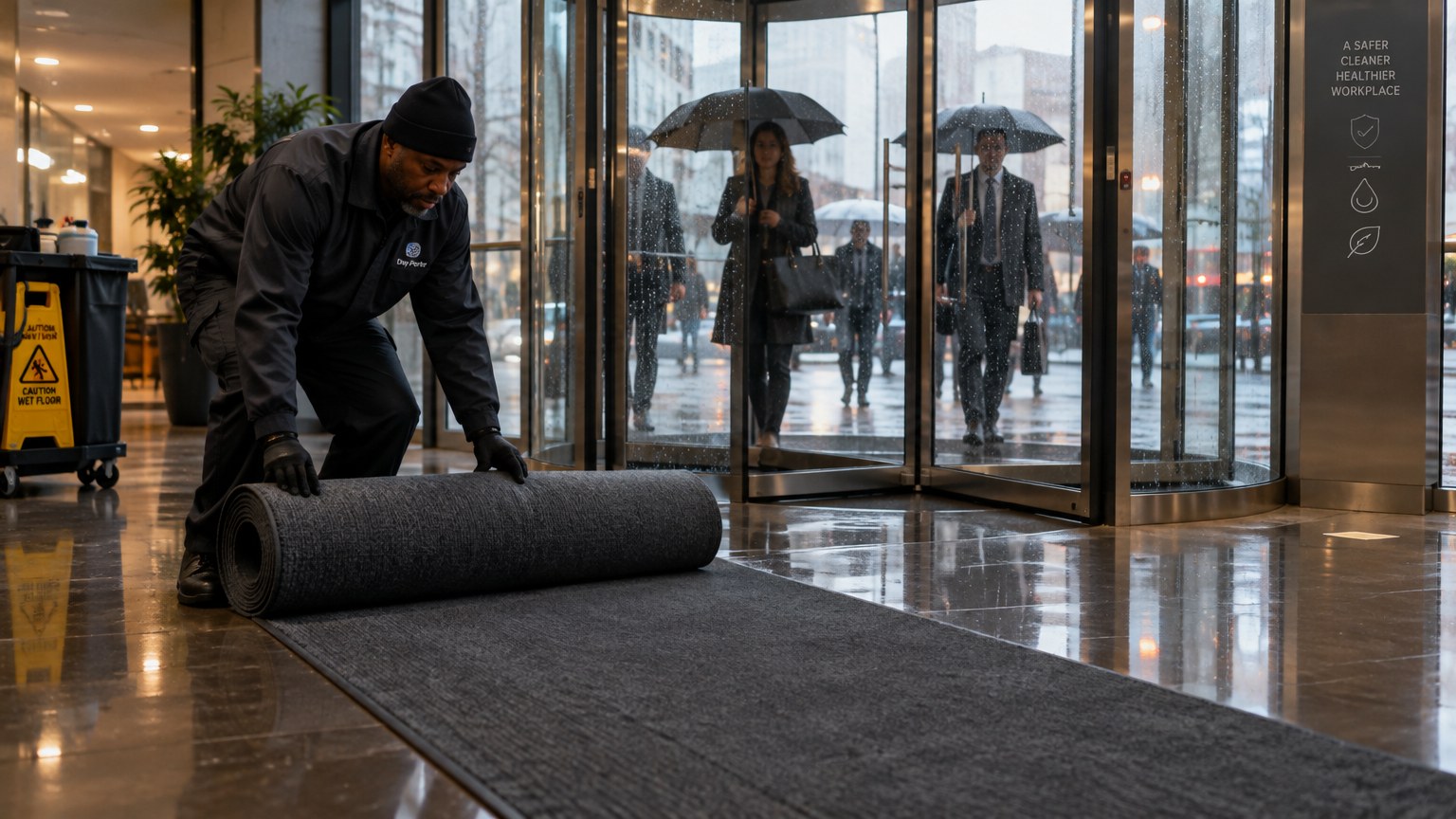
• Safety and hazard response: cleaning spills right away behind wet floor signs, placing weather mats on rainy or snowy days, clearing entry litter, and flagging trip hazards
• Supply management: tracking paper, soap, and liner levels and restocking before dispensers run empty
• Tenant and visitor service: answering cleaning requests, resetting conference rooms between meetings, and helping with light setups for events
• Reporting and coordination: logging issues for the night crew and passing leaks, broken fixtures, or lighting problems to the building engineer
Just as important is what a day porter usually doesn’t do. Repairs to HVAC, plumbing, and electrical systems stay with your engineering team. Heavy projects, like floor stripping or carpet extraction, are scheduled after hours when spaces are empty.
Skills and Qualities of a Great Day Porter
The best day porters combine solid cleaning technique with customer-facing judgment, because they work in front of tenants, employees, and visitors all day. Look for these qualities when you evaluate a provider’s staff:
• Situational awareness: spots a spill, an empty dispenser, or a cluttered entrance before anyone complains
• Professional presence: wears a clean uniform and visible ID, and greets occupants courteously, since a porter is often a visitor’s first impression of the building
• Discretion: works near confidential documents, screens, and conversations without lingering or engaging
• Time management: balances a fixed route with on-demand requests without letting either slip
• Clear communication: writes useful handoff notes and reports problems to the right person
• Consistency: an assigned, long-term porter learns the building, the tenants, and the peak times
Discretion matters most in secure and government buildings, where porters follow escort rules, clean-desk policies, and restricted-area procedures. Our secure cleaning services place fully vetted staff in exactly these environments.
What Training Should a Day Porter Have?
At minimum, a day porter should be trained in chemical safety, bloodborne pathogens procedures, and the cleaning standards your building follows. The BLS lists short-term on-the-job training as typical for the occupation, with no formal education required, so the employer’s training program largely determines quality.
| Training | Requirement or Standard | Why It Matters for a Day Porter |
|---|---|---|
| Hazard Communication (HazCom) | OSHA 1910.1200 requires training at initial assignment and whenever a new chemical hazard is introduced | Porters use disinfectants in occupied spaces and must read labels and safety data sheets |
| Bloodborne pathogens | OSHA 1910.1030 requires training at initial assignment and at least annually for workers with occupational exposure, plus a hepatitis B vaccine offered within 10 days | Restroom and spill cleanup can involve blood or other bodily fluids |
| Green cleaning (GS-42) | Green Seal’s GS-42 standard for commercial cleaning services | Lower-toxicity products and procedures matter more when occupants are present |
| Site-specific procedures | Set by the provider and the facility | Routes, restricted areas, and who to call for each type of issue |
| Security vetting | Background checks or clearances set by the facility | Required for access to secure and government buildings |
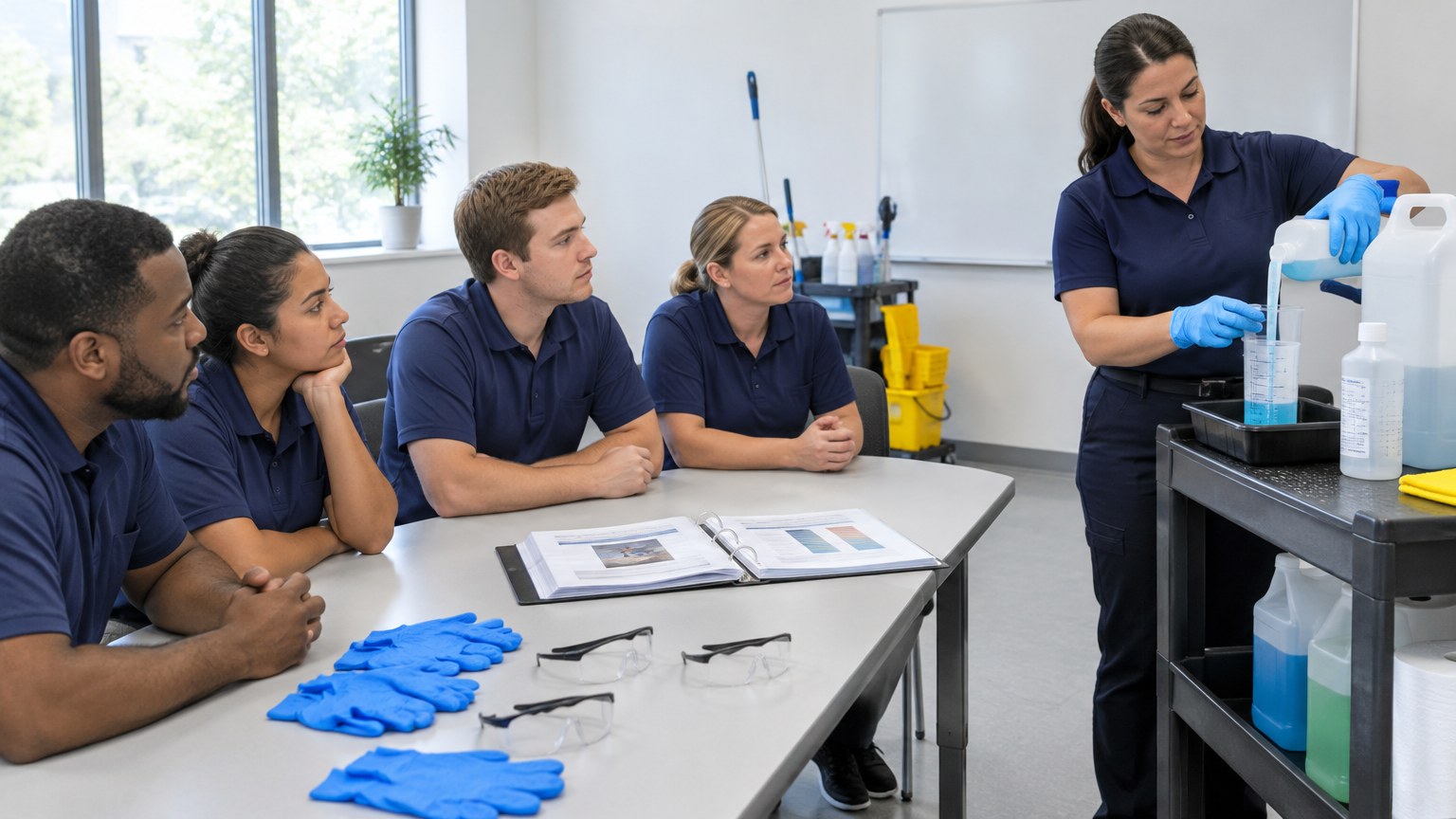
At The Wilburn Company, every team member completes 12 hours of initial GS-42 training and 24 hours of GS-42 training each year after that. Our custodial training program covers safety, bloodborne pathogens, HazCom, green cleaning, and the standard operating procedures for each facility.
Tools and Equipment a Day Porter Uses
A day porter works from a compact, quiet cart stocked for fast response, not the heavy equipment a night crew brings. A well-equipped cart usually includes:
• Color-coded microfiber cloths, with separate colors for restrooms and other areas to prevent cross-contamination
• Dilution-controlled or ready-to-use disinfectants, with safety data sheets on hand
• Wet floor caution signs and a spill kit
• A flat mop system and dust mop
• Restroom restock supplies and trash liners
• Gloves and other personal protective equipment
• A radio, phone, or ticket app for incoming requests
Low-noise, cordless equipment is the standard for daytime work. It lets a porter clean near desks and meeting rooms without disrupting the people using them.
How to Measure a Day Porter’s Performance
Measure a day porter by outcomes occupants actually feel: response time, restroom condition, supply outages, and complaints. Tracking these from the first week gives you a baseline to hold your provider to.
| Metric | What It Tracks | How to Collect It |
|---|---|---|
| Request response time | Minutes from a call or ticket to the porter’s arrival | Ticket or app timestamps |
| Restroom inspection score | Condition at scheduled checks | Inspection checklist or app |
| Supply outages | How often a dispenser ran empty | Porter log and tenant reports |
| Tenant complaints | Number and topic of complaints over time | Work-order system |
| Route completion | Areas serviced compared with the planned route | Daily porter log |
| Handoff log quality | Issues passed to the night crew and resolved | Weekly log review |
A falling complaint count matters more than any single inspection score. It shows the porter is fixing problems before occupants notice them.
When Does a Building Need a Day Porter?
A building needs a day porter when occupants start noticing problems that the night crew can’t reach until hours later. Common signs include restroom supply outages before noon, visible trash in lobbies by mid-afternoon, and tenants asking who to call for a spill.
For coverage levels, staffing models, and what drives cost, see our complete guide to day porter services.
Looking for a trained, vetted day porter for an office, REIT property, or secure facility in the mid-Atlantic? Talk to our team about a walkthrough.
Frequently Asked Questions
Is a day porter the same as a janitor?
A day porter is a type of janitor or building cleaner who works during business hours. The role adds tenant service and real-time response to cleaning, while a typical janitor works after hours on full-building cleaning.
Does a day porter do maintenance or repairs?
No. A day porter cleans, restocks, and responds to spills, but reports leaks, broken fixtures, and lighting or HVAC problems to the building engineer or maintenance team.
What training does a day porter need?
A day porter should complete OSHA Hazard Communication training and, when duties involve possible exposure to blood, bloodborne pathogens training at least annually. Green cleaning training, such as GS-42, and site-specific procedures are also recommended.
What is the difference between a day porter and a lobby porter?
A lobby porter is assigned to entrances, lobbies, and elevators only. A day porter usually covers a route through the whole building, including restrooms, breakrooms, and conference rooms.
Can a day porter work in a secure government facility?
Yes, if the porter passes the background checks or clearances the facility requires. Secure sites also call for consistent assigned staff, escort procedures, and documented logs of areas serviced.