One missed compliance requirement in your cleaning contract can trigger a Department of Labor audit, a contract termination, or a liability finding that lands directly on your desk. For government facility managers in Maryland and Washington DC, the janitorial contract is not an administrative formality. It is a risk exposure that touches labor law, security clearances, environmental standards, and quality documentation, all at once.
Cleaning contract compliance is not a back-office detail. It is an active risk management responsibility, and it starts long before a vendor sets foot in your building. The Wilburn Company has helped government facilities across Maryland and DC navigate these requirements for over a decade, and this guide walks you through exactly what to look for.
> **In this guide:**
> – SCA wage compliance
> – Security credential protocols
> – GS-42 certification
> – Quality documentation standards
> – Low-bid red flags
> – Cleaning vs. sanitizing vs. disinfecting
## What Compliance Actually Means in a Government Cleaning Contract
In a standard commercial cleaning arrangement, compliance is relatively straightforward. The vendor shows up, performs the agreed scope, and carries appropriate insurance. In a government facility context, compliance is a layered obligation that covers how workers are paid, how they are vetted, what chemicals they use, how they document their work, and how they handle access to restricted areas.
The facility manager’s role is not just to hire a cleaning company. It is to verify that the vendor meets every applicable requirement, monitor that compliance throughout the life of the contract, and maintain the documentation to prove it if asked. That distinction matters enormously when a Department of Labor audit arrives or an inspector general review flags your service contracts for examination.
The compliance obligations that typically apply to government building cleaning contracts in Maryland and the DC metro area fall into four categories: labor law, security, environmental standards, and quality documentation. Environmental standards, including GS-42 green cleaning certification, are now baseline requirements in many Maryland RFPs. Each category deserves serious attention during vendor evaluation, not as a checkbox exercise, but as a genuine assessment of operational readiness.
## Labor Law and the Service Contract Act
The Service Contract Act is one of the most consequential and most frequently misunderstood requirements in government janitorial contracting. Enacted to protect service workers on federal contracts, the SCA establishes minimum wage rates, fringe benefit requirements, and safe working conditions for employees performing services under federal government contracts above a defined dollar threshold.
For facility managers, the SCA has direct and immediate implications for how you evaluate bids. The Department of Labor issues locality-specific wage determinations, including rates for Maryland counties and the DC metro area, that set the floor for what your cleaning vendor must pay their employees assigned to your contract. These are not suggestions. A vendor whose bid falls below the SCA wage floor for your locality is either non-compliant or planning to cut labor quality to make the math work. Either outcome becomes your problem mid-contract.
Beyond base wages, SCA-covered employees must receive either a defined fringe benefit package or an equivalent cash payment on top of their hourly rate. When reviewing proposals, look for explicit SCA compliance language and ask vendors to document how they handle fringe benefits. Vague answers here are a red flag.
This is one area where union cleaning vendors have a structural advantage. Companies operating under collective bargaining agreements are already built around negotiated wage scales, documented benefit packages, and defined labor practices. Their compliance posture is not assembled vendor-by-vendor for each contract. It is the foundation of how they operate. As we explored in Green, Secure, and Reliable: The Qualities of Superior Cleaning Services, union labor brings accountability structures that are genuinely difficult to replicate in a non-union environment, and those structures matter most in exactly the kind of high-scrutiny government contract context this guide addresses.
When you are ready to evaluate vendors against these labor standards, our Corporate Office Cleaning Buyer’s Guide for Hiring a Vendor covers the evaluation framework in detail.
## Security Protocols: The Compliance Layer Most Vendors Underestimate
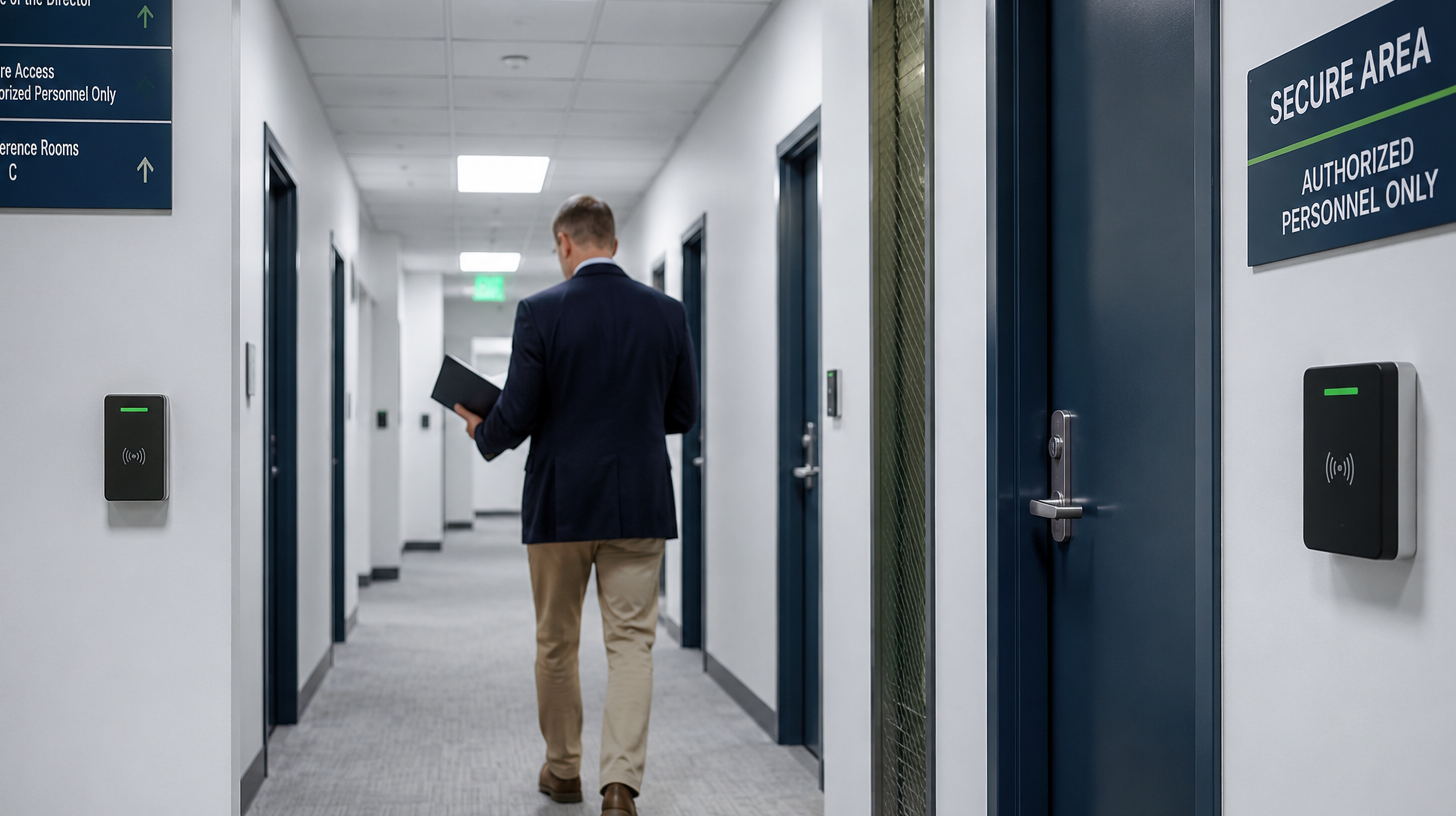
Cleaning staff in government facilities often work in areas that most visitors never access: after hours, in restricted zones, adjacent to sensitive equipment or documents. The compliance obligations around personnel vetting and access control are among the most consequential in a government cleaning contract, and they are also among the most commonly treated as afterthoughts by vendors who primarily think of themselves as cleaning companies rather than security-cleared service providers.
Personnel vetting requirements vary by facility classification, but the baseline for most Maryland and DC government buildings includes criminal history screening, identity verification, and for higher-security environments, employment history and credit checks. What matters from a compliance standpoint is not just that a vendor conducts background checks, but that they have a written policy governing how those checks are conducted, how subcontractors and temporary replacements are handled, and how personnel changes are documented and reported to facility management.
The subcontractor question deserves particular attention. Many government cleaning contracts restrict or prohibit the use of unvetted subcontractors, and vendors who rely on temporary labor pools to fill gaps can inadvertently put your facility in a compliance breach position. Before contract execution, require a written policy, not a verbal assurance, on how the vendor handles staffing changes and what vetting standards apply to anyone who enters your building.
Access credential management is equally critical. Every key, badge, or access code issued to a cleaning vendor represents a security vulnerability if not properly tracked. A compliant vendor will maintain a documented log of every credential issued, with check-in and check-out records for each cleaning shift and a defined protocol for immediate notification if a credential is lost or unaccounted for. In the absence of that documentation, your facility has no way to demonstrate due diligence if a security incident occurs. At The Wilburn Company, our security protocols are structured around exactly these requirements, built to hold up under agency-level scrutiny from day one.
For a full breakdown of what security-ready cleaning looks like in practice across Maryland government and corporate facilities, see our Secured Cleaning in Maryland: Complete Guide for Government and Corporate Facilities.
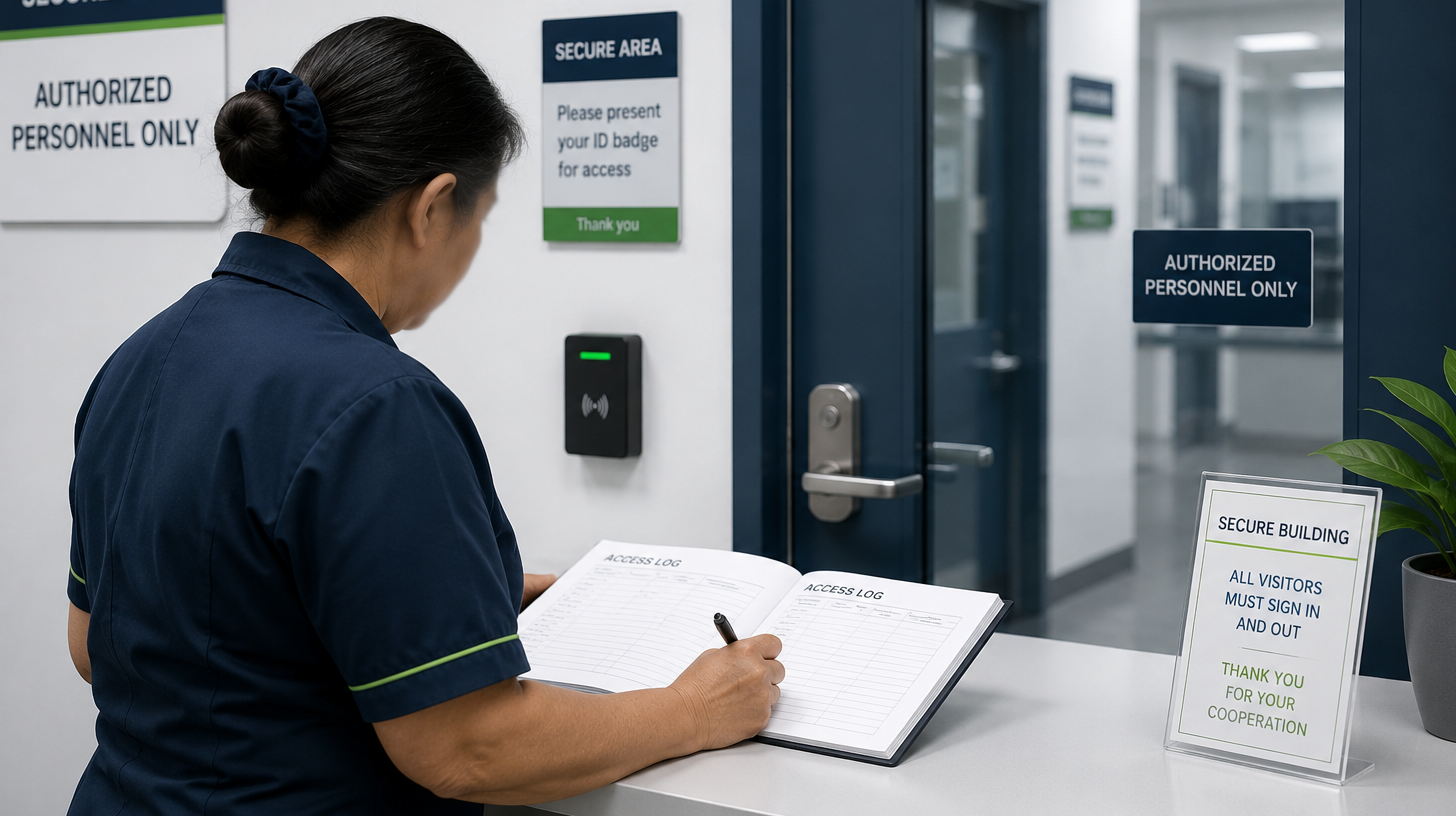
Secure Building Access Log Sign
## Environmental Compliance: Green Cleaning Standards Are No Longer Optional
Environmental compliance has moved from a preference to a requirement in an increasing number of Maryland government cleaning contracts. The state has been active in promoting green cleaning standards for public buildings, and agency-level contracts across the region now routinely include explicit requirements for environmentally preferable products and practices.
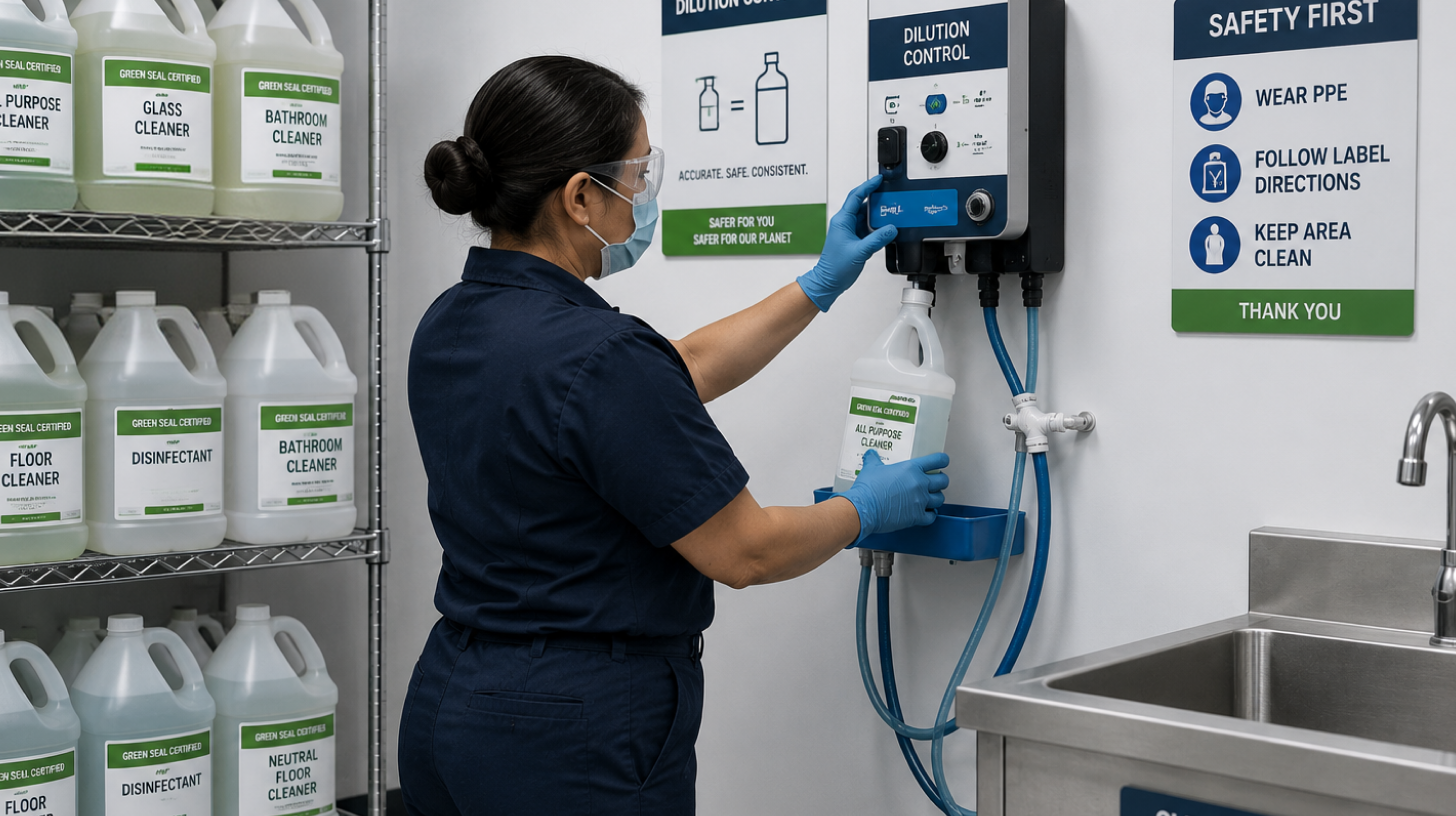
The benchmark standard for government cleaning contracts in this space is GS-42, the Green Seal certification for commercial cleaning services. GS-42 covers product formulation, prohibiting hazardous ingredients and requiring biodegradability standards, as well as dilution control practices, packaging requirements, and indoor air quality impacts from volatile organic compounds. The Wilburn Company holds active GS-42 certification, which means the standard is not something we work toward on a per-contract basis. It is built into every account, every product selection, and every cleaning program we operate.
A vendor claiming GS-42 compliance should be able to produce their Green Seal certification on request. The certification is verifiable through the Green Seal database, and a legitimate GS-42 program has documentation to show. Verbal claims of green cleaning without supporting certification are not sufficient for contract compliance purposes and should be treated as a warning sign during evaluation.
Chemical safety compliance runs alongside the green cleaning requirement. OSHA requires that Safety Data Sheets be maintained and accessible for every chemical product used in the workplace, and in a government facility that obligation extends fully to your cleaning vendor’s product inventory. A compliant vendor maintains a current SDS binder, physical or digital, on-site, and their cleaning staff are trained to reference it. EPA-registered disinfectants should be documented by registration number, not just product name, and that list should be updated whenever the vendor’s product program changes.
Our Green Cleaning Emergency Services with GS42 Compliance post goes deeper on what GS-42 compliance looks like in practice and why it matters beyond the certification itself.
## Quality Documentation: The Compliance Paper Trail That Protects Your Facility
In a government cleaning contract, what is not documented effectively did not happen, at least not from a compliance standpoint. Quality assurance documentation is the evidence base that protects your facility in the event of a complaint, a contract dispute, or an audit. It is also the mechanism through which you actually verify, on an ongoing basis, that the vendor is delivering what the contract requires.
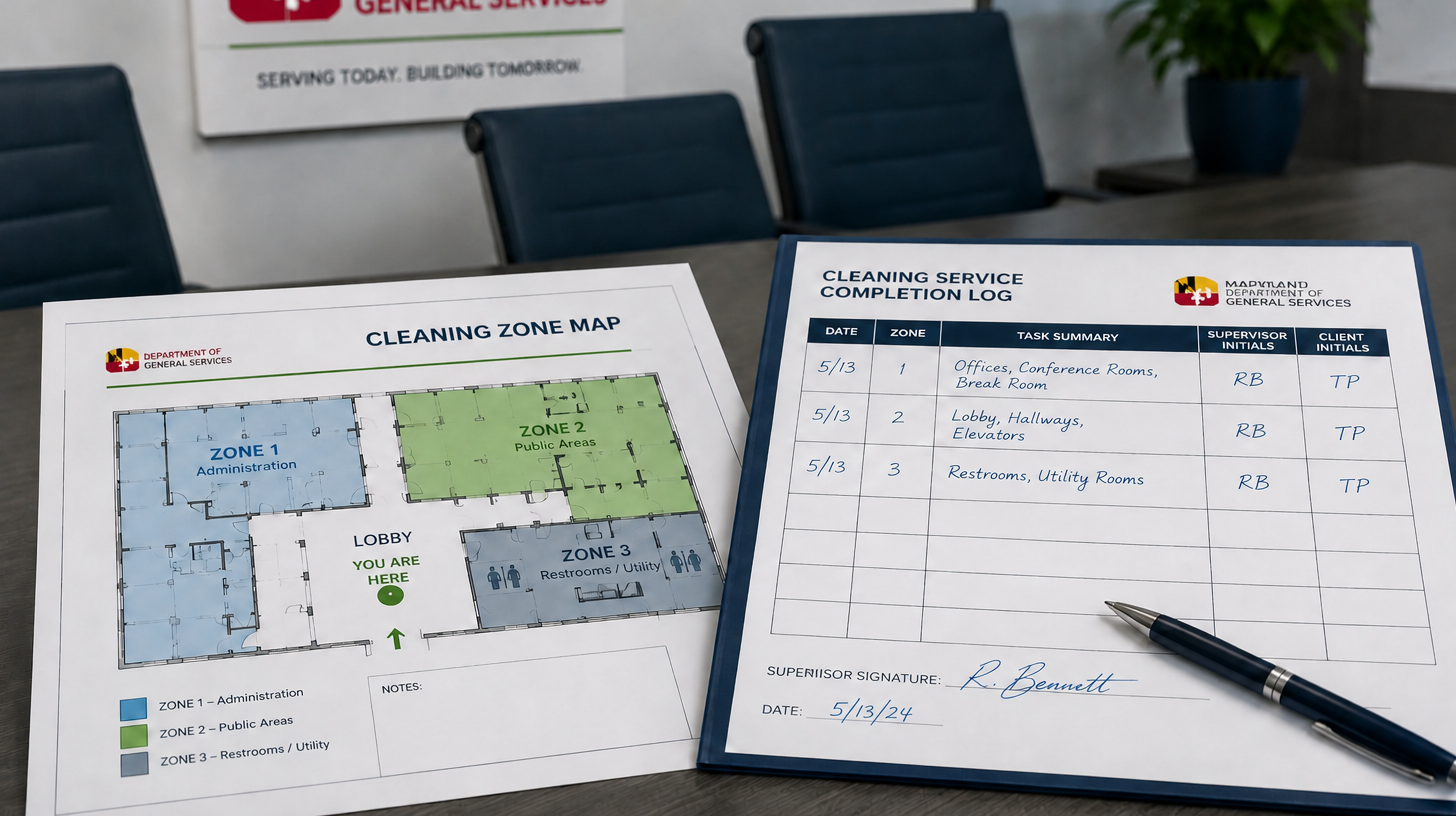
A compliant government cleaning contract should produce zone maps identifying every cleaning area by frequency and assigned personnel, completion logs signed by an on-site supervisor for every shift, structured inspection reports generated on a defined schedule with deficiency tracking and resolution documentation, and incident reports covering any security event, chemical issue, or personnel matter that occurs during cleaning operations.
What facility managers often discover when they inherit an account from a previous vendor, or when they first ask to see documentation from an incumbent, is that the paper trail either does not exist or has never been consistently maintained. The building may have been adequately cleaned. But in a government facility, adequate cleaning without documentation is a compliance liability. If your current vendor cannot produce organized, current completion logs and inspection records on request, that gap needs to be addressed in your next contract negotiation or vendor transition.
The documentation standard you establish at contract execution sets the baseline for your entire oversight relationship with the vendor. Require specifics, not “we maintain quality records,” but defined deliverables with defined frequencies and defined access for facility management review. As detailed in our What Facility Managers Should Expect from Commercial Sanitizing Services guide, the documentation expectations you set upfront are what separate a cleaning vendor from a compliance-ready cleaning partner.
Cleaning Chemical Safety and Dilution Control Instructions
## Cleaning, Sanitizing, and Disinfecting: Know the Difference
These three terms appear throughout government cleaning contracts and vendor proposals, and they are not interchangeable. Using the wrong one in a scope of work, or accepting a vendor who treats them as equivalent, creates both compliance and public health risk.
Cleaning removes visible dirt, soil, and debris from a surface. It does not kill pathogens, but it is a necessary first step because organic matter can interfere with the effectiveness of sanitizers and disinfectants applied afterward.
Sanitizing lowers the number of bacteria on a surface to levels considered safe by public health standards. It does not reliably kill most viruses and is typically used in food service or lower-risk environments.
Disinfecting kills or inactivates both bacteria and viruses on a surface. It requires EPA-registered products applied at the correct dilution and allowed to remain on the surface for the full dwell time specified on the product label. Skipping the dwell time, or using a product not registered for your surface type, means the disinfection did not occur regardless of how much product was applied.
In government facility cleaning, understanding which protocol is required for which area, and verifying that your vendor is applying each correctly and documenting it, is a compliance requirement, not just a cleaning preference. Our Commercial Disinfectant Cleaning Services | Facility Manager Guide covers these distinctions in greater detail for facility managers who need to specify disinfection requirements in their contracts.
## What Low Bids Are Really Telling You
Government cleaning contracts are subject to competitive procurement, and price pressure is real. But in a compliance-heavy environment, an unusually low bid is rarely a bargain. It is a signal that something required has been priced out, and the facility manager is left holding the compliance risk when that gap surfaces mid-contract.
The cost drivers that low bids most commonly exclude or underestimate include the following:
> What compliant government cleaning contracts actually cost:
>
> – SCA-compliant wages and benefits for the specific Maryland or DC locality
> – Background screening administration for all government-access personnel
> – GS-42 compliant product programs with certified chemicals and closed dilution systems
> – Quality assurance infrastructure including inspection programs and supervisory oversight
> – Insurance and bonding at the coverage levels government contracts typically require
When a bid comes in significantly below the field, the right response is not to award it and hope for the best. It is to ask the vendor to walk through their cost assumptions line by line: wages, benefits, screening, products, supervision, and quality assurance. If the math does not add up to SCA compliance and the other requirements your contract demands, the low bid is not a savings. It is a deferred cost that will land on your facility in the form of a compliance finding, a service failure, or a difficult mid-contract vendor transition.
For guidance on what a fully scoped, fairly priced janitorial contract should include in the DC metro area, our Understanding Janitorial Service Contracts and Pricing in Washington DC post walks through the key line items in detail.
## Moving from Compliance Requirements to the Right Vendor
The facility manager’s goal in a government cleaning contract is not just to find a vendor who can clean. It is to find a vendor whose operational model is built around the compliance environment your facility operates in, so that security protocols, labor law, environmental standards, and quality documentation are not add-ons negotiated after the fact, but the way the company runs every account, every day.
At The Wilburn Company, we built our operation for exactly this environment. We bring union cleaning labor, documented security protocols, active GS-42 certification, and a proprietary Performance Measurement Management program that produces the audit-ready quality documentation government accounts require. Unlike vendors that assemble compliance documentation contract by contract, Wilburn builds every account on the same verified security, labor, and environmental foundation, so what you audit at contract signing is what you get on day 365.
For facility managers in Maryland and Washington DC, that combination means a cleaning partner whose compliance posture holds up under procurement scrutiny, not just at contract award, but throughout the life of the relationship. Whether you are preparing a new solicitation, reviewing an incumbent vendor’s compliance posture, or responding to an audit finding, our team is ready to assess your facility and deliver a proposal built around your specific requirements.
Contact The Wilburn Company today to request your facility compliance assessment and tailored cleaning proposal. Contact Us
Call 410-789-3320 or visit [CONTACT PAGE URL] to speak with our team directly.
## Frequently Asked Questions
### What is the Service Contract Act and why does it matter for janitorial contracts?
The Service Contract Act is a federal law that establishes minimum wage rates and fringe benefit requirements for service employees working on federal government contracts above a certain dollar threshold. For janitorial contracts specifically, it means your cleaning vendor is legally required to pay their staff at least the locally prevailing wage rate determined by the Department of Labor for your county or metro area. A vendor who cannot demonstrate SCA compliance in writing is either unaware of the obligation or pricing their bid in a way that puts your contract at legal risk.
### How do I verify that a cleaning vendor’s subcontractors meet the same security and compliance standards as their direct employees?
The prime vendor carries full responsibility for every person who enters your facility under their contract, whether that person is a direct employee or a subcontractor. Start by requiring a written subcontractor vetting policy before contract execution, not after. That policy should specify the background check standard applied to subcontractors, confirm it is identical to the standard for direct employees, and define the approval process your facility must go through before any subcontractor is permitted on-site. Verbal assurances are not sufficient. If a vendor cannot produce a written policy on request, treat that as a compliance gap. Your contract should also require advance written notice of any subcontractor use, your right to reject specific individuals, and immediate removal of any subcontractor who fails to meet the stated vetting standard. Unvetted temporary workers entering a government facility mid-contract are not just a service quality issue. They are a security breach and a potential contract violation.
### How often should a government building schedule deep cleaning versus routine cleaning?
Routine cleaning, covering restrooms, trash removal, hard floors, and high-touch surface disinfection, should occur daily or on whatever frequency your occupancy level requires. Deep cleaning, which addresses high dusting, floor refinishing, upholstery, and restroom deep service, is typically scheduled on a quarterly or semi-annual basis for most government office buildings. Facilities with higher foot traffic, public-facing operations, or post-outbreak conditions may require more frequent deep cleaning cycles. Your vendor should be able to recommend a frequency plan based on your specific building use and occupancy patterns.
### What is GS-42 certification and why is it now required in many Maryland contracts?
GS-42 is the Green Seal standard for commercial cleaning services. It is a third-party verified certification that covers product formulation, dilution control practices, packaging, and indoor air quality requirements. Unlike a vendor’s self-described green cleaning program, GS-42 certification is independently audited and publicly verifiable. An increasing number of Maryland state and local government RFPs now require or strongly prefer GS-42 certified cleaning programs as part of their environmental procurement commitments. Vendors without active certification should not be treated as equivalent to those who hold it.
Developer note: Please apply FAQ Page Schema markup (schema.org/FAQPage) to the four questions and answers above before publishing. Each H3 question and its corresponding paragraph answer should be wrapped in the appropriate Question and Answer schema properties.
Cleaning Zone Map and Completion Log for Government Facility